Showing posts with label rosters. Show all posts

Tuesday, May 10, 2011

Psychology: Self-interest versus collective good

My last post was about how normative practices (such as how players "get next") affect game conditions. I tried to make the point that local rules and norms in pickup basketball profoundly shape the experience of playing.

Thinking about this further, I realized that the specific issue of "next" actually signifies a larger tension—that between self-interest and collective good. Skilled players who advocate a system of next in which captains can cherry-pick their teammates are acting selfishly because under this system, these good players will tend to end up on strong teams and will get to play longer by winning more. Average and bad players, of course, suffer under this system.

There are many pickup scenarios that highlight this tension. Here's one. Have you ever played in a game where one player made a few ticky-tack foul calls? What tends to happen? That's right, everybody starts calling more fouls! So here, Sensitive Foul Guy's behavior shifts the culture of the game. If others don't react by lowering their foul calling tolerances, then Sensitive Foul Guy has created an unfair advantage for him and his team. Of course, this dynamic almost always leads to a series of "That was a foul! That was not a foul!" arguments that threaten to derail the entire run. Increasing foul sensitivity is a great example of the "tragedy of the commons," where everyone would benefit from playing with reasonable fouling standards, but individual players' self-interests undermine this collective goal and ruin it for everyone.

Here's another, less common example. Lately in my pickup run we've had an organizational problem. When the run is especially busy, players like to get two full games going, with winners playing winners and losers playing losers in a "second round." Sounds good, what's the problem? The problem is that this system cannot accommodate new players. So what happens is that the first round games end and teams switch courts to play the second round. But new players invariably show up during the first round and wait by one of the courts. When the second round games are supposed to start, there is almost always a fight between the new players and the players coming over from the other court to play their second round opponent. (This system is stupid but it sounds cool to a lot of people. They need to get their f*cking heads checked.)

The personal interests of the players are clear: everyone wants to play as soon as possible. But multiple teams, according to completely different logics, have the "right" to play. Who capitulates? I DO. As one of the oldest players (and the only professor) playing in a college gym, I feel a responsibility to set a good example, so when I am caught in this situation, I calmly explain why the tourney system makes no sense, and then offer to wait. My teammates are not always happy about this, but I give them my speech about self-interest and collective good and they generally seem to be somewhat sorta kinda ok with it. What strikes me is the reaction of other players, who are braced for an argument and surprised that someone would willingly sacrifice his own playing time. Last week I did this very thing and a player on the team that was jumping us looked at me with genuine puzzlement and said "Wow, you're so nice." I explained to him that I was not being nice, but rather acting in a way that set a positive example so that we would all eventually benefit. I asked that next time he was caught in a situation like the one we were in, he volunteer to sit and wait. He furrowed his brow and appeared to consider it before checking the ball in and starting play. Baby steps I guess.

Final example. The other day I was ahead of the entire defense on a break. My teammate threw me a great over-the-top pass and I had a clear path to the rim. But as I caught the ball my feet got mixed up and I shuffled slightly before taking two big steps and laying the ball in. I think it looked a little funny, but no one on the other team said anything because it was a marginal situation. I turned right to my opponents and said "I traveled. No basket." They were shocked. My teammates were shocked. In response I simply said "integrity of the game."

I hope that by setting a good example I will encourage others to think of the collective before thinking of themselves. I want to create a culture in which personal sacrifice is normalized, where players are willing to act against their own interests when they recognize that the collective good is at stake. I often talk to other respected regulars about this. I tell them that we all need to think of the good of the game before we think about ourselves. But this is difficult in pickup basketball—a loosely organized activity with an ever-changing roster of participants. The problem with asking players to attend to the collective is that the collective is amorphous and unbounded. Still, I feel that if the most respected players actively promote honorable behavior, others will be inclined to follow suit. The players I talk to seem to understand this in theory, but when there's a three game wait next Sunday afternoon, we'll see.

I'll close with some simple but powerful advice. When faced with a self/collective dilemma, we should always ask ourselves: What would Jesus Shuttlesworth do?

Wednesday, April 27, 2011

The science of next

Ok, let's get a little social sciency up in here. I want to discuss something I've thought about for a long time: How does the process of "getting next" affect the dynamics of a pickup game? I've played in a lot of different games with various ways of doing this, but I think that there are two main procedures in the U.S.

Through democratic selection. The next five players to show up get next game, regardless of who they are. In general, those who have been waiting the longest are the next to play. If there are fewer than five players waiting, losing players engage in a shooting contest to fill the available spots. This is the most common form of next.

Through conferred authority. The next player to arrive becomes team captain. The captain has the liberty to accept or reject other players who ask to play with him. If the captain wishes, he can even select players from the losing team to join his squad, despite the fact that they are "jumping over" players who have not yet played. This is a less common arrangement, and I've mostly seen it practiced on the east coast.

Now I'm going to argue that the conferred authority method is worse on all counts. For years in Boston and New York, I played in games that used the conferred authority method, and it never made sense to me. Why not?

1. It lacks consistent internal logic. This method causes massive confusion. Who has next? Can I play with you? Why not? If I can't play next, can I play with the team waiting second next? Third next? Where is my place in the queue of nexts? At its worst, the conferred authority approach can produce a long string of captains with no teammates, each waiting to cherry pick the best players from losing squads. When games get crowded, the system's vague logic and players' intense desires to play spark a conflagration of arguing.

2. It unfairly stacks teams. This method eventually creates extreme team inequalities. Next teams are invariably getting stronger and stronger because they are selecting the best available players. Weak players, meanwhile, are being sent to the back of the line. When these weaker teams finally make it onto the court, they are quickly dispatched by the high quality team that currently owns the run. Ultimately, the weak players leave because they keep losing and then they have to wait an hour to play again.

3. It changes the culture of the game. Winning becomes the primary goal of playing. This is because the conferred authority method essentially changes the game's supply and demand of players. Since some players are in more demand than others, the likelihood of playing after losing is variable across players. Those who do not expect to be picked up by a next team must win to keep playing, or they will be subject to the humiliation (and long wait) of finding a spot amongst the sea of nexts. The need to win is a direct reflection of self-interest, which runs rampant under this system. Average/bad players who do not advocate for themselves will not play very often. (Good players will get picked up again no matter what their personality.) Thus, all average players must seek above average teammates to increase the chances of victory, and at the same time, above average players seek to avoid playing with the average players.

4. It encourages shady behavior. For all the reasons described above, players (especially captains) must use deceptive tactics to keep their teams strong and avoid relegation to "last next." This usually involves dissuading or refusing subpar players who ask to play. The most common form of shady behavior is when a waiting captain targets a star player who is currently playing and holds a spot for that player, even though others are coming up and asking to play. Again, this is technically allowed, but it just seems unethical. Many times, I'd approach a waiting captain and ask to play, only to be told that "his friend was in the bathroom." Of course, when the next game started, the "friend" turned out to be a star player who just lost. When shady behavior is built into the norms of the game, the norms of the game should be questioned.

Overall, the conferred authority method produces more competitive games, but also more stress, conflict, and unhappiness among players. I also feel that it compromises the integrity of the pickup game because it is so profoundly undemocratic. The larger point here is that the structural conditions of play can exert significant effects on who plays, how the game is played, and how players relate to the experience of playing. The conferred authority approach leads to a competitive environment structured rigidly around a hierarchy of skill. On the other hand, the democratic method mitigates this hierarchy and fosters a fair-minded approach to the game where playing time is freely available, regardless of how good you are.

Saturday, August 15, 2009

Who WAS that guy?

At a recent pickup session, I ended up on a dream team and we went on an amazing run. If I could have drafted any four gym regulars onto my team, I would have chosen my talented, unselfish, hardworking teammates. We won four or five games in a row—none of them close—and felt that we would own the court until we ran out of gas.

A mediocre-looking team came on to play us. They had four average players and one guy we had never seen before. He was in his 20s, in extremely good shape, and I swear, he looked like a male model. (Later, I found out that he actually is a male model.) Male Model looked like he could play, but we had mismatches at four other positions and didn't think that his team would pose much of a challenge.

We were wrong. On the first possession of the game, Male Model drove through our entire defense and hit an unbelievable twisting layup. We figured it was a fluke, until he did the exact same thing on the next possession, and the next. After his third ridiculous layup, we completely collapsed the lane on him, so he pulled up from long range and swished a rainbow jumper. At this point we were in shock, but managed to get it together and revved up the offense. Although Male Model was a great defender, he couldn't guard all five of us and we exploited other defensive weaknesses for buckets. But at the other end, Male Model was literally unstoppable. We switched three different defenders onto him and he smoked them all. Every time we got a basket, he came down and responded in spectacular fashion. While our scores were of the traditional "find the open man" variety, his were improbable and demoralizing. We were in a tizzy because we had no answer for his Kobe Bryant act.

It was close at the end, but Male Model got the best of us and we lost. It was heartbreaking for three reasons. First, our dream team had been vaporized. It's so rare to end up on a team like that, and when it happens, you just want it to go on forever. Male Model crushed our dreams. Second, it sucks to get beaten by one player. Losing to a better team is understandable, but when your team has mismatches at four positions and the fifth player singlehandedly takes the game away from you, it's a bitter pill to swallow. Third, and perhaps most importantly, the player who wrecked us was a complete unknown. None of us had ever seen him before.

I've always found it harder to be dominated by someone I don't know than someone that I do know, and I think this is true for most recreational ballers. Why is this so? I'm guessing it's some sort of tribal thing. (Any anthropologists reading this?) We'd rather be defeated by someone familiar because their place in the local hoops hierarchy has been established. A guy like Male Model disrupts our sense of that hierarchy. His presence pushes all other players down a notch and also "breaks the bubble" of the game. By this I mean that pickup games with regular rosters are somewhat insulated from the larger world of basketball. We know, in theory, that there are much better players (and games) out there, but because we play with others on our level, we fool ourselves into thinking that we're better than we really are. When a talented outsider shows up and tilts the game, we get a window into the world of better basketball and our true place on the global hoops totum becomes clearer. If basketball is a form of escape, as it is for most casual players, who needs that pesky dose of reality?

Male Model has actually become a regular player in our pickup game, which has restored a sense of equilibrium. He is still a great player, but it turns out that he was really on fire that first day. Some of the better defenders have figured out how to contain him so that he doesn't take over every game anymore. (I personally cannot guard him at all and become mildly incontinent whenever he matches up with me.) More importantly, we know him now. It turns out that he is a pretty nice guy and we like having him around. And of course, I'd rather have my ass busted by someone I know than by a stranger.

Thursday, July 02, 2009

Rosters: Managing the list

This summer, I've been organizing pickup hoops at my university's gym. I'd heard that the pickup scene is usually pretty dead during the summer, so I spent the spring collecting e-mail addresses from the regular players and compiling them into a list. It's been great so far. I've got more than 40 players on the list and we get 15-20 out there every time I send out a basketball alert.

Overall, I like administering the list because I can virtually guarantee that any time I want to play, there will be others to play with. I also like the fact that I have some control over who gets on the list, and more importantly, who is excluded from it. Now don't get me wrong
—this isn't some velvet rope thing, and it certainly isn't as exclusive as this basketball list. I invited almost all the regular players at the gym. However, I was also able to subtly exclude a few bad apples by intentionally failing to mention the list when they were around.

But now the list has grown beyond my control. People talk about it during our pickup runs and I am getting quite a few referrals via e-mail and in person. In principle, I have no problem with this, but the existence of the list is so well-known at this point that it can no longer be hidden from those that I wanted to hide it from.

This guy, for example, is one of the biggest doofuses in the gym and I had taken great pains to keep him out of the loop. But the other day I was running in a game and I heard him yell to me from the sideline, "How come I didn't get on the e-mail list?" Others must have been talking about it. I was overcome with two distinct negative emotions. I felt guilty for excluding him and I also felt annoyed that he was acting so entitled about getting on the list. Ultimately I had no choice but to add him and now he's coming almost every time (and acting like a fool).

On the one hand, I feel like a jerk for applying my own standards of play and personality to list membership, even if those standards are fairly lax. Isn't this the sort of anti-democratic elitism that we want to eliminate from our society? Haven't we all felt bad for being excluded from something? On the other hand, some dudes are meatheads and need to stop playing competitive sports with reasonable people. Moreover, I am constrained by my position at the university. If I were a student, I could probably be more of a hardass about restricting inclusion on the list. But as a professor (and the only one who plays pickup ball), I feel a duty to act charitably and promote harmony in the university hoops community.

I feel that this issue reflects a fundamental dilemma in the democratic process. In theory, democracy is a good thing because it is inclusive and fair. But at the same time, democracy is messy and inefficient because all voices demand to be heard. (In this case, all players demand court time.) Even America's founding fathers designed our wacko electoral system to limit the irrational and uninformed influence of the masses. Why shouldn't I be able to limit the influence of mean, unsportsmanlike players?

Friday, March 06, 2009

"Worse than he thinks": Self-image versus ability

I recently wrote about appearance versus ability—specifically, about players who are "better than they look" and those who are "worse than they look." Another important issue, and one that is a source of endless frustration to thinking ballers everywhere, is self-image versus ability. To me, the worst players to run with (aside from the belligerent and insane) are those with drastically inflated self-images. You know these players. They're the ones who think that they're the best on the court, the ones who think they know how the game should be played and how you should be playing it.

There are a lot of things to despise about these types. They often tend to ballhog. They "coach" a lot, telling others what to do and where to go. The construct completely distorted histories of games and their roles in those games, rarely blaming themselves for losses but almost always overstating their contributions to victories. But what I hate most about these players is that there is nothing you can do to make them understand the lunacy of their perceptions. There is no such thing as constructive criticism. In fact, there is no place for criticism at all, unless they are criticizing you. After playing with a worse-than-he-thinks player, one is invariably frustrated. You know, and others know, that worse-than-he-thinks is indeed, worse than he thinks, but there is nothing you can do to make him grasp that. Ignorance might be bliss for him, but certainly not for us.

In my experience, worse-than-they-think players tend to overfocus on their good skills and ignore their weaknesses. Such a player might be a good jumpshooter, and ramble on incessently about this shooting prowess, but never acknowledge that he fails to effectively rebound, defend or pass. When his ballhogging costs his team the game, worse-than-he-thinks will chastise his teammates for failing to hit shots, rebound, defend or pass. Argh.

There is an older guy in my current run that is the epitome of this type. I really don't like him, nor do the other thinking players at the gym. Last night, he was on a very good team and spent a lot of time puffing his chest out and acting like he was the king of the court. The truth was that his teammates were carrying the load and all he was doing was yapping like a miniature dog. When my team played his team, I was forced to guard a strong, highly skilled player. On one play, worse-than-he-thinks set a screen for my man, who hit a long, contested three (I managed to get over, but a little too late, and my man hit a good shot.) Coming back down the court, worse-than-he-thinks sidled up next to me and exclaimed, "THAT WAS A BIG PICK RIGHT THERE," as if he was the one who deserved credit for the shot. I wanted to smack him in the mouth.

Here again, the words of Obama brother-in-law Craig Robinson echo in my mind:
"You can tell a lot about a guy by the way he plays basketball. You can tell if a guy is selfish. You can tell if a guy is phony. There's a lot of different ways on the court you can tell that." My view is that the on-court personality issues of worse-than-they-think players seem to be exhibited off the court as well. Whenever I encounter one of these self-absorbed douchebags in real life, they turn out to be, well, self-absorbed douchebags.

Any advice on dealing with these types?

Friday, February 27, 2009

"That guy is better than he looks": Appearance vs. ability

Here's a topic I think about all the time: What factors most affect opinions about players' skills, and by what process do those opinions change? In pickup basketball, there are often unknown players rotating into the playing roster. For purposes of team selection, shot distribution and defensive assignment, other players must evaluate them quickly and make uninformed assessments about their prospective abilities. It's like speed dating.

In my view, the following characteristics carry the most weight in these initial evaluations:

Height: The taller the better.

Fitness/build: Overall, the fitter the better. Moreover, players who have a "basketball build" (lean and athletic) also experience an initial status upgrade.

Age: The age-status curve is shaped like a bell. Players who appear to be in their early 20s to early 30s have the highest status, as they are believed to be mature enough to have absorbed necessary knowledge of the game, but young enough to still run and jump effectively. The very young and the very old have the lowest status.

Race: In general, black players get the most credit. Asian players get the least credit (believe me on this one).

Attire: This is complicated and multifaceted. Length of shorts is key. Tightness of shirt and style of sneaker are also important factors. Players who wear NBA jerseys, or worse, full NBA uniforms, lose credit. Players who wear the jerseys of teams that they appear to have actually played on get a lot of credit.

Language: Players who speak competently about basketball (e.g., "screen and roll," "going left") will get credit. Those who obviously lack hoops vocabulary will lose credit.

Certainly there are others, but these, in my opinion, seem to be the main criteria by which new players are judged. However, what's even more interesting to me is the process by which players rise and fall in status as their actual abilities become known. Specifically, I think that initial status characteristics are integrally related to status mobility. Here, I propose two interrelated hypotheses:

H1. Players who look like they'll be really good, but who turn out to be average or bad, lose status much more quickly than players who look like they'll be bad and actually turn out to be bad (the "worse than he looks" hypothesis).

H2. Players who look like they'll be average or bad, but who turn out to be good, gain status much more quickly than players who look like they'll be good and actually turn out to be good (the "better than he looks" hypothesis).

Evidence for these propositions can be found in almost any pickup game. I feel like players who "look the part" but don't have the skills to match are severely denigrated (e.g., "waste of height"). Conversely, players who look ordinary but who exhibit great skill come to be held in extremely high regard. My favorite example of this was one of my hoops mentors in college. Pete was this tiny Vietnamese guy—literally 5 feet tall—but he was lightning fast, passed like Stockton, and had insane handles and deeeeep range. He would also pick your pocket if you stopped paying attention for any amount of time. Guys were always underestimating him and getting their asses busted. I was guilty of this as well. The first time I guarded him during my freshman year, he got the ball on the perimeter and pump faked. I went up thinking I was going to swat his shit into oblivion, but found myself way up in the air as he ran through my legs and laid the ball in. (Spectators and other players, of course, went crazy.) Then, because I was scared to bite on any more shot fakes, he proceeded to hit about 500 threes in my eye over the course of the night. Over the years, I saw Pete victimize countless suckers like this, and he was considered a legend in our college gym—the prototypical "better than he looks" baller.

Monday, April 28, 2008

Relationships: The poisonous player


Have you ever played in a game in which there was one person who just ruined it for everyone else? In my favorite weekly pickup game, there is a guy who comes semi-regularly and poisons the whole atmosphere. Old School and Hops both play in this game, and they will agree that this guy (I'll call him "the Idiot") is a serious problem.

The Idiot is actually a good player. He is in great shape, works hard on both ends of the floor, and has a versatile game. Unfortunately, he is also psycho-competitive and talks constant trash. Now, I'm not opposed to a little trash talk, but the Idiot takes it way too far. His banter is not at all playful and he invariably upsets someone to the point of fighting (usually verbal, but it has escalated beyond that). He also likes to denounce his opponent after his team wins
—in my opinion, a form of unbelievably poor sportsmanship. I'm the type of guy that normally recoils from conflict, but a couple months ago I got into a screaming fight with the Idiot because he was being such a jerk to one of my teammates that I couldn't hold my tongue any longer. In fact, the Idiot pretty much gets into a fight with one or more players every single time he plays. (If you're wondering if I'm doing any racial coding here, it should be noted that the Idiot is white.)

I think that the crux of the problem is that the Idiot's style is totally out of sync with the culture of the game. His never-ending belligerence shuts everyone down emotionally and saps all the fun out of playing. I've played in games where this kind of behavior would be slightly more appropriate, but the game I'm talking about is a "nice guys" game. The same people
come out every week. We all know each other and for the most part, genuinely like each other. The games are very competitive, but the governing code of the court is to be considerate, friendly, and a good sport in both victory and defeat. Trash talking is kept to a minimum, and when it's done, it's without malice. That's why the Idiot stands out so much. His poisonous attitude is just a total wrench in the works. Last week, to the shock of many, one of the nicest players in the game lost his temper and yelled at the Idiot: "This game is normally so much fun—except when you're here!" The rest of us were thinking the exact same thing.

The basketball court is one of the few venues in polite society where strangers can come together and compete in a casual way. Everyone has a right to show up and play, but when games develop a regular cast, as ours has, there is a tendency to want to exert control over the playing roster. However, there is no easy way to exclude someone like the Idiot from participating. We hoop in a public park and abide by the rule that if you show up and call next, you play next.

So Setshotters, what can we do? Is there any way to discourage him from playing? And when he does show up, how can we minimize the effects of his poisonous personality?

Sunday, April 09, 2006

NBA: Your fave all time starting five


So, if all of you setshotters had to pick a starting five that you would love to watch play for an afternoon, (assuming all players are in the prime of their career), who would be on it? I would have to go with the following:

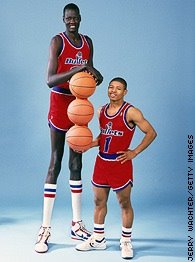
PG Muggsy Bogues
SG Earl Boykins
SF Michael Cooper (for the socks and the D)
PF Charles Barkley circa his days with the Sixers
C Manute Bol

Not much else to this post, but it'll be interesting to see who people come up with.


Sunday, October 09, 2005

Players: Playground taxonomies


It appears that one of the biggest cliches in pick-up basketball writing is the taxonomy of playground ballers. In fact, I remember writing one for Sister Eustacia's English class in ninth grade. An earlier post mentioned the The Spaz, The Fat Kid Who Stands at the Three-Point Line All Game, and The Guy Who Calls a Foul No Matter What. There have also been posts and comments on the Ballhog, the Coach, and the Big Mean Guy.

The following links offer detailed taxonomies. None are great, but they give a sense of the genre.

For profiles of the Shit Shot Artist, the Quick Whistle and the Labrador Retriever click here.

For the Rocket Arm and the Kung Fu Master, click here.

And for a discussion of which NBA players fit which types, including Reggie Miller as the Guy Who Calls Too Many Fouls, and Jon Barry as the Guy Who Just Bought an And 1 Mixtape, click here.

Add your own types below.