Showing posts with label careers. Show all posts

Monday, February 21, 2011

Psychology: Intraracial rivalries

"Is he better than me?"

That's the first thing I asked when I heard about a guy my old NYC running mates were calling "Jeff 2.0." Jeff 2.0like mewas an undersized, pass-first point guard with good handles and a decent jumper. He was also Asian.

In December, I got together with my NYC basketball friends to play in their regular weekly game. Jeff 2.0 was there and it was the first time we had met each other. He seemed like a very nice guy and he definitely had some game. We ended up guarding each other for most of the night. I played my ass off against him and at the end, I felt that I had done respectably, especially since I had just come off major knee surgery. But it got me thinking about intraracial competition. Jeff 2.0 and Jeff 1.0 (me) were the only two Asians in the gym that night, and I felt that we were both subtly trying to capture the "Best Asian in the Game" award. Unfortunately, as we know, there is no such award.

I think that an easy hypothesis here would be: Players will play harder against same-race opponents.

But I don't think it's that simple.

The better hypothesis is actually: Players will play harder against same-race opponents when their race is relatively rare in the game.

Growing up in upstate New York in the 80s, I didn't know any other Asian ballers. In most games I played in, I was the only one. Going to college in Boston, I met a few other Asian players, and I definitely played harder against themwanting very much to be the best Asian around. I mean, there was no way I was going to be the best player on the scene, but I had a really good shot at being the top Asian (and I think I was). I moved to NYC for grad school in the late 90s, and found myself in a tough situation. I played with quite a few Asians at the gym and in the parks, where there was no guarantee that I'd be anywhere near the best. There were definitely some Asian ballers at NYU who could easily bust my ass back up to Poughkeepsie. I would play SO HARD against them, but they were just better than me. I remember one of the "kings of the gym" (a black guy) coming up to me one day and saying something like "You're the second best Asian brother here. You've got a good game, but [the other Asian] is the best." I couldn't disagree, but I was stung by the truth of what he had said. I hated that anyone else knew what I knewthat I wasn't the best of my kind.

But then I moved to Berkeleyaka the Land of Asians. I started balling at the UC Berkeley gym and at various parks around town. Now, instead of being one of a few Asians, I was one of many. In fact, some of the games I played in were all Asian. Suddenly, being the top Asian player didn't seem so important anymore. For one, there was no way that this was going to happen. There were too many Asians playing in my games now, and too many of them were clearly better than me. But more importantly, the social structural conditions of the game had changed my perceptions. I found that with so many Asians to compare myself to (and to be compared amongst themselves), I didn't feel that same intraracial rivalry.

So I believe that racial uniqueness plays a critical role in this dynamic. When there are only a couple of you, you see an opportunity to gain status in the eyes of the local hoops community. As I have mentioned elsewhere on this blog, I like it when good players give me a racist nickname ("Yao," "Ichiro," "Duck Soup"), as it means that I am noteworthy, despite the general disadvantage of my race. But when your racial category reaches a certain tipping point, this status competition becomes more or less moot. You'll never get a cool racist nickname if there are fourteen of you.

Thinking about this suggests a further complication, which is that overall racial category statuses also matter. For example, if two relatively skilled black players are playing with eight white guys, do they feel the same pressure to be the best of their race? Maybe, but maybe not, as black players tend to have higher status generally in pickup basketball culture. For those with high hoops status, being the best of their kind may take a backseat to being the best, period.

Thus, I think that the best hypothesis of all is: Players will play harder against same-race opponents when their race is relatively rare in the game, and they are in a relatively low-status racial category.

And of course, here's the question we really want answered. Does intraracial rivalry affect the highest levels of play? Do Kirk Hinrich and J.J. Redick get insanely pumped up to guard each other?

Friday, February 11, 2011

First day in the brace: Outclassed

I couldn't wait until this weekend. Yesterday I went to the gym in my new knee brace to "shoot around and do drills." So I shot around and did drills--for about an hour. Then players started showing up. The first time I was asked to play I politely declined. But the second time I was asked I eagerly accepted. How many times can you put drugs in front of an addict and expect him to refuse?

The main reason I decided to play was that the game looked soft. Most of the players were undergrads and they were not particularly good. If there was any game I was going to be able to play in, this was the one.

My stat line from that game: 0 points (0 for 0 shooting), 0 rebounds, 5 assists, 1 turnover. I assisted on every one of our team's baskets in a losing effort. One of the assists was a sweet behind the back pass through two defenders. I take responsibility for the turnover, although a better big man would have caught it and laid it in.

This game was both encouraging and frustrating. I was encouraged to realize that I could still defend, handle the ball, and pass. But I was frustrated to realize that I was not able to get any decent looks because of reduced mobility and psychological issues related to my knee. I decided to try playing in another game.

But the game suddenly changed. All the mediocre undergrads left and better players took over. This happens a lot at our school gym. The goofy games run from 4:00-5:30, but then all the grown-ass men get out of work and show up. Between 5:30 and 8:00, the games are very competitive. Still, I wanted to see what I could do against better players. The answer: basically nothing.

My stat line from the second game: 0 points (0 for 0 shooting), 0 rebounds, 1 assist, 2 turnovers. It wasn't that I was tired. The game just got too good for me. My defender was significantly better than the kid who had guarded me the first game. My teammates were also much better this time around, pushing me far down the offensive hierarchy. Everyone was much better this time around. I was simply outclassed.

I am ok with this. I'm just coming back after a two month layoff. I have spent a lot of time learning to accept age and infirmity. I play because I love to play. Despite feeling limited and old yesterday, I had so much fun. And last night, for the first time in a long time, I dreamed about playing basketball.

Tuesday, February 08, 2011

Equipment: Bracing myself

I've suffered a setback on the path to recovery from ACL surgery. In December I was playing pickup in NYC and, on the very last play of the entire night, tweaked my surgically-repaired knee. It didn't feel that serious at the time, but some swelling persisted and for a few weeks after, it just felt weird. I went to see my ortho doc, who examined my knee, told me that it seemed loose, and ordered an MRI. The MRI showed some fraying and stretching of the ACL, but my doc did not recommend surgery. Instead, he suggested I "brace it" and gently return to basketball.

At first I was happy with this diagnosis. Another surgery was the last thing I wanted, never mind the ensuing rehab. But today I went and got my brace. This thing is a f*cking monster! (The pic on the left is the actual model I got.) It's pretty light, but I've been wearing it all day and it definitely lets me know that it's there. It also makes me feel like a character in a sci-fi movie who's been partially reconstructed with robot parts.

Over the years, I've seen many aging ballers wearing these big-ass braces (including Old School after his own ACL repair). To be honest, my opinion of these players was a mix of admiration and pity. I admired them for gutting it out after their bodies had failed them, but pitied them for having those same failing bodies. When we are young, it's hard to imagine a time when we will need such equipment to continue playing a child's game. It's easy to scoff at the old guys doing everything they can to keep up. But soon enough, we are those old guys, and we are faced with enormous, pressing questions.

-Should I keep playing?
-Should I retire?
-What can I expect from myself on the court now?
-What skills must I develop to keep playing effectively?
-What exactly is this "golf" that ex-ballers seem so obsessed with?

The brace serves as a constant reminder that I am on the steep part of the downward curve of hoops ability. It also suggests that I've taken basketball to a certain logical endpoint in my life. When I'm sacrificing my future health for a few moments of adrenaline on the court, I'm not so sure my priorities are in order. In a way, bracing my knee means bracing myself for the inevitable.

Still, I'm going to keep playing. I'm lugging this brace over to the gym this weekend and testing it out. Even though I'm older, slower, and partially robotic, I can't let go of the game that easily, especially after the surgery and rehab I've gone through in order to keep balling. There's got to be a few kids I can still cross up, right?

Setshotters: Please share your knee brace stories with us.

Tuesday, November 16, 2010

Careers: A love affair, interrupted

In March, five days after my intramural team won the league title, I was playing pickup ball. I drove the lane, jumped, landed, and felt my left knee come apart. The pain was incredible and I knew that I was in serious trouble. My ACL was blown. I had surgery, followed by months of physical therapy.

I thought about retiring from basketball. I figured that I had had a good run of it, and I had reached the age (35) when most professionals begin practicing their color commentary. Now obviously I'm no professional, but I was left wondering whether I had reached hoops menopause.

Unsurprisingly (if you know me), I dismissed the possibility of retirement pretty quickly. I love basketball too much, and the months off just underscored how important the game is to my life. Retirement felt like an unwanted divorce. ("Baby please! We can work this out!") Within weeks I was doing dribbling drills in my garage. I couldn't wait to start physical therapy, rehabilitate my knee, and get back to playing. I would ride my bike to the park, sit in the grass near the basketball courts, and pretend to read a book while ogling the pickup games. The only thought in my head: "I need to get back out there."

Well, I'm back out there. I started playing a few weeks ago and told myself I'd take it slow, which I have, but not by choice. I'm taking it slow because I am slow. Amazingly, I'm ok with this. I'm just so happy to be playing again that I don't care about how good I am. My stamina is poor and my shooting can best be described as erratic, but my ballhandling is solid (drills in the garage) and my court vision is undiminished. Instead of trying to be mid-career Jason Kidd, I'm happy to be late-career Mark Jackson. I don't need to be an alpha dog anymore.

Priorities matter. Younger players often don't have fun unless they win. I have fun no matter what. Winning is important to me, but not at the expense of camaraderie, honor, and the sheer animal joy of playing. Winning is not what I have been missing. Glory is not what I have been missing. Basketball is what I have been missing. And here's the actual bottom line: you don't end a 20-year affair because your lover inadvertently gave you a boo-boo.

Friday, March 12, 2010

The emotional complexity of an intramural championship

So my team has won the intramural championship. Overall, it's great. We worked really hard, came together as a team, beat some excellent opponents, and truly had a blast during the season. The playoffs were challenging and exhilarating. As the number two seed, we cruised through the first couple of rounds, then faced an extremely tough team in the semifinal with one extraordinarily skilled playera former D1 shooting guard. Luckily, they had just played an exhausting quarterfinal, while we won ours with ease. (The semifinal was the second of two games on the same night.) Because they were tired and we were not, we pulled away in the second half and won by 20.

We had expected to play the number one seed in the final, but incredibly, they lost their semifinal game because they could only field five guys and basically ran out of gas. So we faced the twelve seed, the defending intramural champion and a team that was much better than their seeding would suggest. (Also, a team with a ridiculous name: "O U NO FO SHO.") The game was close throughout
both teams playing with real passionbut our best players went into high gear at the end and iced it. Afterwards, we got our championship t-shirts and had our picture taken for the website and a banner that will hang in the gym's fieldhouse. I should have been elated, and part of me was, but it was more complicated than that.

I had sat on the bench during the most crucial stretches of the final game so that our best five could play more minutes. This was the right thing to do, but after the game, I wondered if I should have felt bad about not contributing more. I definitely thought that I had done my part during the season, but at the same time, I think that the team could have won without me. Even though I was technically the captain (because I had filled out the registration form), I was also a replaceable part.

I've played on league teams where I was the best player, which I did not really like, but I've never played on a team where I was one of the worst. Intellectually, I was able to accept my reduced role, but when the buzzer sounded in the championship game, my animal ego stung more than I thought it would. As our team picture was being taken, I had a couple of dispiriting thoughts. First, how much longer can I play at this level? This season was tough on me, as I was constantly matching up with quicker, stronger players. Second, will I continue to be ok with being a role player? Will my role get smaller and smaller? How small will it have to get before I am not ok with it?

I have some time to think about these things, but next year, when I look up at our championship banner, I wonder if I will feel pride, guilt, or both.

Monday, November 09, 2009

Intramural update: "No your roll"

To start, an anecdote from Jack McCallum's book :07 Seconds or Less. When journeyman Ledell Eackles played for the Miami Heat, his contribution to one particularly memorable team meeting was walking up to the whiteboard and writing, "No your roll." Teammate Glen Rice's reply: "Sit down, dumbass."

Ok, I mostly included that because I think that the story is funny, but it also relates to this post.

At the halfway point of the season, our intramural team is 4 and 1. The first game seemed a bad omen: we played very poorly and lost to a team we should have beaten. The second game resulted in a win, but not an encouraging one. We played a team that was significantly worse than us and barely survived. I think that our main issue was getting adapted to one another. None of us is really used to playing with so many capable teammates, so we were all deferring too much, especially to our star forward (who was also deferring). We also lacked defensive intensity because we were still getting used to the refs and were not sure what their fouling tolerance was going to be.

But the last three games
all victorieshave been great. Our defensive intensity is way up and guys have really been looking for their shots. The ball movement has been excellent. Our big men have dunked on many fools. One game we shot about 60 percent from three and rang up the highest score that the league has seen this year (80).

The biggest issue that I have had to deal with personally is learning to be more of a role player. When I play pickup at the gym, I'm generally the 2nd or 3rd shooting option and the main ballhandler/distributor. That means that I have the ball in my hands a lot and feel like I can take a substantial number of shots during these games. But our intramural team is so good that I've had to accept a lesser role. I come off the bench, don't get to handle the ball as much, and take far fewer shots than I'm used to.
The real difficulty for me is negotiating the tension between deferring to better shooters and retaining enough aggression to still be effective on the floor.

When I was younger, this situation might have been more bruising to my ego, but I'm actually happy to be a second banana on this team because my teammates are so skilled and it's clear that I should not be one of the primary scorers. The culture of our team softens the blow as well. Everybody is really supportive of one another and that makes it easier to accept reduced responsibility. When I initially put the team together, I prioritized inviting high-character players because I knew that getting along was much more important than assembling transcendent talent. As I watch our opponents snipe at each other
after losses, I know that this decision has payed off.

I'm still struggling to no my exact roll, but I'm confident that I can make peace with this. We're getting better with each game, and the more we embrace our proper places on the team, the better we will ultimately become. Tougher opponents await us.

Friday, October 09, 2009

Last chance for glory?

I've decided to play intramural basketball this year and I've assembled a team of nice, talented players. It wasn't an easy decision for me. I'm an untenured professor who should be spending his evenings slogging away at journal articles and class lectures. I'm also an aging baller with cottage cheese ankles and an ever-growing list of bodily creaks and cracks.

So why did I do it? Well, the more I thought about it, the more I realized that I don't have many chances left to play competitive basketball. The other day I was telling a younger player about a shot I am developing this year (a fading turnaround jumper from the low post). He asked me why I was bothering. I told him that at my age, you lose something every year, so you have to add something to make up for it. He laughed, but I was dead serious. Every year I lose more and more: quickness, hops, strength, willingness to absorb contact, mental acuity. Eventually I won't be able to add enough each year to compensate. Next year I'll be worse than I am now. The year after that, worse still. So, I thought that if I am going to captain a team to a "title," I've only got a few shots left.

We'll see how it goes. We're playing in the competitive league, so our opponents will probably be pretty good. I've got some ringers on my team though, including a guy that played for our university (i.e., D1 skillz). My teammates, to a man, are unselfish, skilled, physically strong, and hardworking. We're called the Manhandlers for a reason.

First game is this coming Monday. If this is my last shot at glory, I'm ready for it.

Tuesday, October 28, 2008

Careers: A 73 year-old college basketball player!

I've just come across this amazing story about a guy returning to play junior college ball at the age of 73. Previously, Setshot has reported on a 52 year-old college player and a 50 year-old WNBA player, but this guy's story seems patently absurd. Ken Mink last played organized college basketball in 1956. Now a semi-retired journalist, he's somehow made the team at Roane State Community College in Tennessee.

There is video of Mink practicing with the team here and here. While the whole thing seems kinda gimmicky, and it's clear from the video that Mink is not really on the same level as his juco teammates, you've got to admire the guy's moxie. The Roane State coach says he hopes to get Mink some minutes during garbage time in blowouts. Setshot will be eagerly awaiting those YouTube clips.

A fantastic quote from the coach: "Our weakness last year was experience; I think I've taken care of that.''

The best part of the video is near the end, when Mink's teammates ask him to come to a party. The coach discourages it because, he claims, Mink will need to stay in top condition to continue practicing and playing. And then Mink calls his wife to ask if he can go, and she says no.
In response, the coach praises Mink's "support system at home." I love that:

a. He is asked to go to the party.
b. He wants to go to the party.
c. His coach does not want him to go to the party.
d. His wife does not want him to go to the party.
e. He apparently needs a "support system" to keep him from making reckless decisions.


**UPDATE 11/4/08: Mink scored 2 points in his first game! Video here.**

Friday, August 08, 2008

Careers: Being old and new, part 2


Things are coming together basketball-wise here in Denver. I've found a pretty good Sunday afternoon run and I've also started to play a little at my new school's gym. The games there are good exercise and fairly fun, but they've definitely highlighted the fact that I am significantly older than most players on a college pickup court. Luckily, I look young and can pass for a student-type, but as we have said many times on this blog: it's not how old you look, it's how old you feel.

Yesterday I was at the school gym shooting free throws by myself when what appeared to be the entire women's basketball team rolled in. I wasn't sure what to do, so I asked one of the players if they were practicing. She said that they were just playing pickup and that I was welcome to join in. I ran with them for a couple of games, but pretty much stayed out of the way and kept quiet. The players were really nice, but I felt like I was intruding and I absolutely did not want to be the doofus who tried too hard to impress all the ladies. After a while, some regular joes
—mostly college-agedstarted to play on the next court over. I told the women I was chatting with on the sidelines that I was going to "go play with the civilians" and one of them replied "yes, you should." Very subtle.

Eventually, the civilian game got enough players for full court and we started to run. It was a decent game and I was one of the better players on the court, so feeling outclassed or out of place were not issues. But during (and between) games I noticed that the other players seemed to be taking the outcomes very seriously
—often criticizing teammates for defensive lapses and poor shot selection. Losing players seemed to be genuinely upset as they sat and waited for next game.

Now that I'm an older player, it's easy for me to forget how important everything seems to younger guys, and how, so often, basketball outcomes stand in for their larger senses of self worth. I've played so much pickup ball in my life that every outcome
—from the most devastating loss to the most unlikely victory—has happened to me a million times. Don't get me wrong, I'm competitive and I always play to win, but the disappointment of getting smushed on the court does not linger emotionally for me any more. I know that there will always be another game, and that all wins and losses eventually fade into obscurity. To me, what matters the most is one's reputation as a competitor and a sportsman.

After games, I would go and shake hands with every person on the other team, telling them that they played well (whether they had or not) and that the game was a lot of fun (whether it was or not). Many of the young guys actually seemed surprised by this
—like you're not supposed to commiserate with the enemy or something, and that "fun" is not really what pickup ball is about. It reminded me of how much my perspective on recreational hoops has changed over the years, and that for younger guys, victory and personal performance seem far more important than camaraderie and sportsmanship.

So while I will continue to play at the school gym because it is close and convenient, I'd like to find a group of older players to run with. I may look young, but man, I feel old.

Thursday, July 31, 2008

Careers: Being old and new

I've just moved to Denver from the Bay Area. In a lot of ways, the move is great: great new job, great new apartment, great new city. What's not great is that I have to find new places to play basketball. I've moved a lot in my life, and each time, I've had to find good pickup games in unfamiliar places. It's always tough, and even tougher now that I'm old and crabby. As a younger guy, I'd play in any game I could find, but now I'm much more picky about quality of play, and more importantly, level of sportsmanship. Plus, I have to reestablish myself in new socio-hoops environments, which can be stressful.

I've been in Denver about two weeks now and I still haven't found a decent game. One reason for this is that it's incredibly hot
like record-breakingly hotso no one is playing outdoors.

Yesterday I went to a rec center near my apartment and found a few guys shooting around. We all shot for a while and then made an awkward transition to two-on-two. The game was pretty good. My teammate, incredibly, had played basketball for my alma mater. He was a terrific player with a deadeye jumper and seriously polished moves around the rim.
Our opponents were also quality players. One was a high-school kid who claimed that he almost broke the state record for three-pointers. I'm not sure I believe that, but he was indeed a very good shooter.

We won a couple of games
—mostly because my teammate was unstoppable. I played pretty well, repeatedly posting the high school kid up and tossing in various old man shots (he hated it and was despondent about being "shitted on"), but after two games I was done. The altitude just destroyed me! Each game was to fifteen, and by eight I was begging for the end. By fifteen I was clutching my shorts, gasping and unable to speak. I should have expected this, as I've routinely been running out of breath while performing strenuous tasks like climbing stairs, walking to the store, and petting my cat.

So now I'm facing a sorta-Catch-22. I want to find some full court games to play in, but I'm not sure I'll be able to keep up because of my sea-level conditioning. However, the only way I'll get into mile-high shape is to play in said full court games. And the whole dilemma is irrelevant if I can't find any games to actually play in.

I'll keep you posted on the Denver Old Man Pickup Hoops Scene, and if anybody out there knows of good runs in the 303/720, please let me know.

Friday, July 25, 2008

Women's basketball star returns to action—at 50!

Our friend and fellow aging baller Ali directed us to this story about women's basketball legend Nancy Lieberman being signed to a seven-day contract with the WNBA's Detroit Shock. Liebermanwho has already been inducted into the Basketball Hall of Fame (in 1996!)returns to play at the ripe old age of 50. In her "first" game with Detroit, Lieberman recorded zero points, two assists and two turnovers in nine minutes of action.

Wow! While Setshot has previously drooled over expressed admiration for Iowa's "Granny Basketball League," Lieberman has taken old lady hoops to the next level. Whether you care about women's basketball or not, this story is an inspiration.

Monday, May 19, 2008

Tips: Kareem 's advice to players over 40

Kareem Abdul-Jabbar writes a cool blog for the LA Times that reports "the insights of the NBA's all-time leading scorer."

Recently, I was directed to this entry, in which he gives some solid advice to ballers
over-40 who want to keep runnin' with the young-uns. In so doing, Abdul-Jabbar touches on issues that have become Setshot staples: lack of respect, diminishing abilities, and increased injury risk, to cite a few. I'd recommend reading his post, which is pretty brief, but if you need further brevity, here's a summary of Kareem's advice:

1. Lift weights.
2. Stay in shape and keep your cardio conditioning up.
3. Specialize more in your play.

By the way, that's a vintage photo of Kareem giving me basketball advice in the 1970s. He was demonstrating a technique called "Kermit Washington style."

Thursday, April 03, 2008

Seriously, Barack Obama is a baller

Last year, Setshot endorsed Barack Obama for President based on reports about his lifelong love of basketball. By all accounts, he continues to play and so, like each of us, he is an aging baller. Now, as if speaking directly to the Setshot community, he has promised to build a basketball court in the White House if he is elected.

Can he be President, like, now?

What's more, he wants to build his court over a bowling alley that Nixon commissioned. Out with the exclusionary, imperialist Alley of Shame and in with the Obama Hardwood of Racial Harmony!

Setshotters, here's the real question: How are we going to finagle ourselves a pickup game on President Obama's court? Could it be as easy as showing up and calling next?

*Update: Great footage from HBO showing Obama playing pickup ball. He looks pretty good, but clearly can't go right at all. Thanks to our friend Sully for the link. And another clip from friend and Jazz fanatic Matt. Sweet passing!

A news article about the Obama Court is reprinted below.

Basketball court in White House future?
By Bob Kravitz [Indianapolis Star, April 1, 2008]

Many years ago, President Richard Nixon had a small bowling alley built in the White House.

If Sen. Barack Obama is elected president, he will replace the bowling alley with something more suitable to his tastes: a basketball court.

"There's not only a chance (that he'll have one built), but it's a guarantee," Obama said Monday on WFNI 1070 The Fan.

When it comes to basketball, Obama knows his stuff. During a 10-minute conversation, he talked about his NCAA bracket -- well, what's left of it. He talked about his days as a high school player in Hawaii, where his team won the 1979 state championship. He brought up Eric Gordon, saying "he could use some guidance." And he talked about becoming the Baller In Charge, saying he would have a basketball court constructed inside the White House.

"I tried bowling (Sunday) in Pennsylvania and threw two gutter balls," Obama said. "So we'll have a basketball court, at least a decent half court."

As a high schooler, Obama wore No. 23. "I was No. 23 before Michael Jordan was 23," he said with a laugh.

He described himself as "a slasher, a three, maybe a poor man's Scottie Pippen or Tayshaun Prince -- a guy like that without as much talent.''

Monday, February 13, 2006

Careers: Playing for peace

UConn hoops fanatic and friend of Setshot Suzanne referred us to this organization. "Playing for Peace" is a non-profit agency that bridges social divides, develops future leaders, and educates kids through basketball. Their modus operandi appears to be getting kids from opposing social and political groups to play ball together: white kids and black kids in South Africa, Catholics and Protestants in Northern Ireland, Israelis and Palestinians in the Middle East.

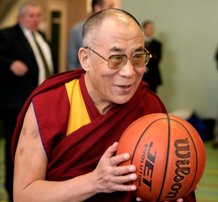
It looks like they're getting some good publicity. Steve Kerr is an advocate, and the Dalai Lama (pictured) is reported to have been breaking ankles and backboards at a recent exhibition, earning the streetball nicknames "Monky Business" and "Transcendental Conflagration." (Ok, I made those up.)

Playing for Peace has a bunch of interesting-looking job opportunities at its various sites. It could be a good way for the aging baller to prolong his involvement in the game while doing good in the world.


Sunday, January 22, 2006

Could you score on an NBA player? A quasi-empirical test


A few months ago I wrote a post wondering whether an ordinary pickup basketball player could score against an NBA player if the pro was playing his absolute hardest. This post generated a fair amount of conversation, with most respondents thinking that they could not score.

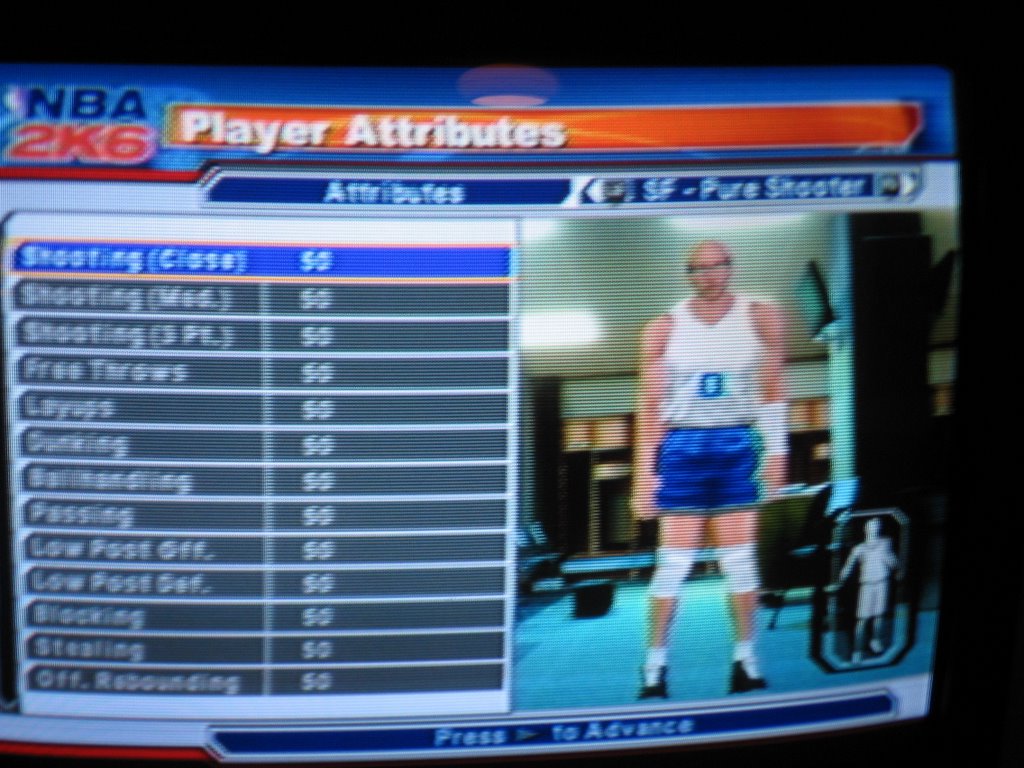
Cary and I decided to explore this issue using the latest in basketball simulation technology: NBA2K6 for Playstation 2. We created a character called Joe Setshot -- a 5'8" small forward with knee pads, Stockton shorts and male pattern baldness. Setshot was given the lowest possible rating in every skill category (50), so as to best approximate the abilities of an average player.

Cary and I then conducted a totally unscientific test of the "Could you score?" hypothesis. We made Joe Setshot play one-on-one against three NBA players: Wang ZhiZhi, Paul Shirley, and Kobe Bryant, alternating users in an attempt to control for video gaming skill. Would our man be able to get a bucket? Results after the jump.

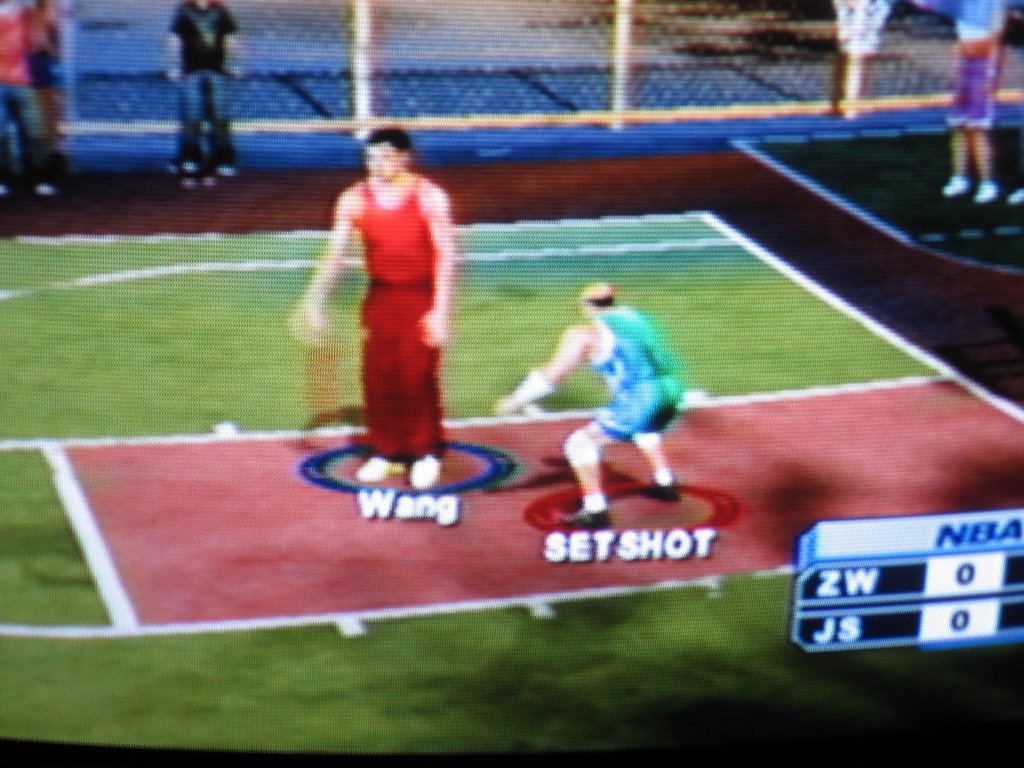
The first match was Setshot versus Wang ZhiZhi, whose player rating of 63 is among the lowest in NBA2K6. We played winners' outs. Results, with user in parentheses:

Wang (Jeff) 15, Setshot (Cary) 0

Wang (Cary) 15, Setshot (Jeff) 1

It was impossible for our man to stop Wang. The pro was too strong and too fast. As soon as Wang got the ball and started moving toward the hoop, Setshot would be bumped backwards until he was forced out of position, and the towering Chinaman would lay it in. I did manage to score one point during my turn as Setshot, but this happened because Cary/Wang turned his back on defense and I was able to get an open layup. It's important to note here that I have owned this game for about a month, and while Cary is an experienced video hoops player, it was his first time playing this particular game on this particular system. Even with this skill disparity, the match was obviously quite lopsided.

Our second series put Setshot against Paul Shirley, who is the lowest rated player in the game (53). Results:

Shirley (Jeff) 15, Setshot (Cary) 0

Shirley (Cary) 15, Setshot (Jeff) 4

Again, Setshot was completely unable to stop Shirley, with the pro hitting a variety of layups and short jumpers to control the game. However, Cary got distracted for a minute and I was able to score four points in succession during my turn as Setshot. As soon as Cary pulled it together though, Setshot was shut down and Shirley cruised to victory. Remember again that this was Cary's first time playing the game.

Finally, just for fun, we made Setshot play against an NBA star, choosing Kobe Bryant. Results:

Bryant (Jeff) 15, Setshot (Cary) 0

Bryant (Cary) 15, Setshot (Jeff) 4

As Bryant, Cary went into a Non-Persistent Vegetative State and allowed me to score four times in a row, but basically, it was all Kobe. He threw down an array of awesome dunks -- their sheer force often knocking our man clear off the court. Bryant also hit a variety of difficult jumpers and fadeaways, taking great pleasure in toying with his lesser opponent. Hilariously, the game's AI made Setshot talk trash throughout the contest, even asking "Is that all you got?" as Bryant flushed the game-winning dunk in his face.

So what can we conclude from this? I think the experiment was slightly corrupted by a discrepancy in user skill that allowed me to score a few times as Setshot. However, in general, it seemed clear that with the pro user defending competently, it was impossible for Setshot to get a clean shot off. And as soon as the pro got possession, the game was over. Furthermore, the Joe Setshot character was probably significantly better than the average pickup player. We set his skill level at the bare minimum, but my impression was that the average player would still be much worse. (Note to video game companies: Let the skill ratings go down to zero.)

I'll stand by my assertion that the typical pickup baller could not score on a pro if the pro was playing his hardest. However, I invite others to improve on our methodological design and contribute to this important area of scholarship.


Sunday, December 11, 2005

Careers: When to retire? Part II


For the last month or so, I haven’t been in the mood to post on Setshot. I’ve been too worried about my knee. In mid-October, I played in the most intense game since my return from ACL surgery three years ago. Not only was the game tough, but I was overmatched, and to make matters worse, my wife happened along--compelling me to exert myself well beyond my capacities. It turns out she wasn’t even watching. It seems they never are (see Girls Ain't Nothin' But Trouble).

After the game, my knee hurt differently than it ever had before and was a little numb. The pain didn’t go away for weeks. I made an appointment with the doctor and joined the injured list. Retirement seemed imminent.

Every other night, I sat down at the computer to write a new post, but I couldn’t do it. Jeff wrote posts about trash talking and scoring on an NBA player and old man moves, but I just couldn’t match him. I wrote a few posts about stuff I found on the web, but I couldn’t bring myself to write anything personal. Jeff suggested I write about being injured, but I just couldn’t face it. Part of it was that I wasn’t having many hoops experiences in my street clothes. But most of it was that it just made me too damn depressed. Could it really be over?

Earlier, I had hoped that Setshot might be a place that both current players and retirees could enjoy, but if I was typical, retirees would avoid the site like the plague.

This week, I finally got to the doctor. He told me it wasn’t my ACL, but probably just a meniscus problem. He advised against surgery because the meniscus is serving a purpose. Instead, I should just play with the pain (which really is quite minor) and keep building up my quads.

I could have kissed him. He saw how happy I was and said “Keep on playing. Keep on playing. It’s good for you. We’ll work through this.”

"I play too,” he said with a grin. I immediately told him all about Setshot.

“I’m 58”, he said. “I’m always the old man of the court. But I can shoot a hook with either hand and nobody can stop me.”

If you’re reading, Dr. Old Man of the Court, thank you very much. Jeff just e-mailed about a regular run at Strawberry Creek Park. The guys are at our skill level (me, moderate-to-bad; Jeff, awesome) and “more importantly, they seem like polite and considerate young men.” I’m so ready.

Monday, November 14, 2005

NBA: Paul Shirley on retirement


Former NBA benchwarmer Paul Shirley writes a fantastic blog about the life of an ordinary NBA basketball player. He is articulate, funny and honest. Today's entry is particularly relevant to Setshot, as it's about the prospect of retirement. He says that he idolizes Mark Pope, who retired this year without apparent regret, and plans to enter medical school.

Shirley got some attention last year with his "Road Ramblings" blog -- in which he wrote about being bored in practice, being bored on the bench, being bored on the road, and liking girls a lot. He tagged himself as an "embedded journalist," and was recently rewarded with a book deal from Random House.


Thursday, November 10, 2005

Players: A 52-year-old college basketball player!

Here's a recent story from the Detroit Free Press to inspire us all. Maybe this guy can be Setshot's official spokesman.

Aging rookie gives college players run for their money

IRONWOOD, Mich. (AP) -- Gogebic Community College basketball players have a new incentive not to break team rules or skip practices: They might get benched in favor of a 52-year-old man.

Russ Maki, who is studying criminal justice at the Western Upper Peninsula school, has earned a spot on the roster as a walk-on.

"It's been a great experience, bonding with these younger guys," Maki told the Daily Globe for a story this week. He made a brief appearance in the Samsons' opening game Tuesday night but didn't score.

A long-ago member of the Wakefield High School squad, Maki played last year on a city league team with the Gogebic assistant coach, who encouraged him to try out. The head coach, Deke Routheaux, gave the OK.

"I was a little surprised he was willing to do this," Routheaux said Wednesday, adding that Maki was in "great shape."

There was one problem: Maki, who runs an insurance company, didn't attend Gogebic. So he enrolled as a full-time criminal justice major.

"Well, if the insurance business goes bad, I guess I can be a cop," he joked.

After working out with the team for a week, he decided he could keep up with the other guys and stuck with it, scoring nine points in a recent scrimmage.

Maki's life is hectic nowadays. Classes start at 8 a.m. He works at the insurance agency from noon until basketball practice, which ends at 5 p.m. Then he does homework and lifts weights for an hour.

He also squeezes in time for his wife and two daughters.

"It'd be nice to have 36 hours a day," he said.

Routheaux is noncommittal about playing time for Maki, but says he's a valuable addition to the team.

"He's an inspiration for the other players to work hard and be on time," Routheaux said. "They respect what he's doing and he fits in well with these guys, doing the little things right, playing hard. If he can get up at 6:30 in the morning, they shouldn't whine about it."

Maki said he shows up 30 to 45 minutes early for practice and tries to hustle during all the drills.

"I do it to show I can do it, and it seems like the players kind of follow suit," he said.


Wednesday, October 12, 2005

Careers: When should I retire?


In my late twenties, I witnessed a graybeard with a potbelly, a hunchback and a bad knee lurching after a rebound at the NYU gym. I was appalled. I'd already been having back problems of my own. I didn't want to end up like that. I resolved that I would quit at 30 and switch to something less taxing like swimming or tennis. But 30 came and went and I didn't retire. One evening at 33, I blew by my man, blew out my knee and sprawled into the lane. I'd never been in so much pain.

The doctor told me that I could either have ACL surgery or avoid sports with lateral movement. I chose surgery mainly because the doctor asked if I might want to play ball with my kid some day. I never intended to return to pickup ball, but the surgery and the recovery were so painful and laborious that I needed something to inspire me--and basketball became that thing. After several years of exercise and tentative forays onto the court, I'm finally playing a couple of times a week again.

But my friend Mike, who has retired, is always in the back of my mind. He just had his surgery for his third torn ACL--all from basketball. He misses the game, but not enough to risk another surgery.

The roster of the Sunday Morning Hoops Site at UT-Austin is full of knee injuries and Jason Jimerson, Professor of Pickup Basketball in Indiana, has now retired after knee surgery.

And yet I'm out there. I tell myself that it won't happen to me. I've been diligent about my rehab. I'm still doing all those leg exercises at the gym. I'm cross-training.

But after a few full-court games on Sunday, I had the worst knee pain since my surgery. I was worried at first, but it appears to be a temporary setback. Still, I should probably retire at some point. My body won't hold up forever and my game's definitely not improving (even with the addition of old man moves). But when? I still love the game. I love the movement, the complexity, the court-sense, the characters, the high-fives. I love blowing by my man. So when?

Here is you where you can post your own struggles with retirement (or non-retirement).

Tuesday, October 11, 2005

Careers: The decision to go pro

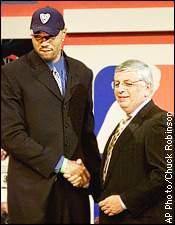
Did you know that anybody can register for the NBA draft? It's free, and very easy.

I did this in 2000. A friend told me that I would have to write a letter to David Stern stating that I was giving up my remaining college eligibility (I had four years left) and declaring myself available for drafting. The NBA sent me back an application and a form letter saying that I would be entered into the draft upon the application's return. Some highlights from my application:

Height: 5'8"
Weight: 135 (my skinny days!)
Number of years played high school basketball: 0
Number of years played college basketball: 0
Other relevant information or special skills: Excellent sense of color. The ability to love unconditionally.

On draft night 2000, I was in a bar in NYC, and very drunk. I had no idea that the draft was taking place that night, until I looked up on the big screen TV and saw my competition lumbering around in horrible suits and poorly-fitting caps: K-Mart, Stromile Swift, Joel Przybilla. Unbelievable! Przybilla becomes an instant millionaire and I'm drunk in a dive bar! Joel Przybilla certainly does not have the capacity for unconditional love. And what, may I ask you, does the NBA need more? Another big clumsy benchwarmer, or someone who can finally love professional hoopsters the way they deserve to be loved?

I was too traumatized to try for the CBA, and became a sociologist instead.